
HomeAsian CricketA Ten-Ball Cameo and Ranji's Empty Chair: What Suryakumar Yadav's Return Really Says
A Ten-Ball Cameo and Ranji's Empty Chair: What Suryakumar Yadav's Return Really Says
প্রশ্ন: MCA প্রেসিডেন্ট'স কাপে সূর্যকুমার যাদবের প্রত্যাবর্তন কেমন ছিল? সংক্ষিপ্ত উত্তর: সূর্যকুমার যাদব MCA প্রেসিডেন্ট'স কাপে ১৫৪ রানের তাড়ায় MIG ক্রিকেট ক্লাবের হয়ে ১০ বলে ১৭ রান করেন, স্ট্রাইক রেট ১৭০.০, তিনটি চার, কারান ভদ্রর বলে স্টাম্পড। এটি ক্লাব-স্তরের ক্যামিও, Form-রায় নয়। মূল তথ্য: - সূর্যকুমার ১০ বলে ১৭ রান করেন, তিনটি বাউন্ডারি সহ, স্ট্রাইক রেট ১৭০.০, এবং স্টাম্পড আউট হন। - তিনি জুন থেকে প্রতিযোগিতামূলক ক্রিকেটের বাইরে ছিলেন; সর্বশেষ ভারতের হয়ে টি-টোয়েন্টি বিশ্বকাপ ২০২৬ ফাইনাল খেলেন। - মুম্বাই রঞ্জি ট্রফি ২০২৬-২৭-এর ১৬ সদস্যের দলে (অধিনায়ক সিদ্ধেশ লাদ) তিনি উপলব্ধ থাকা সত্ত্বেও বাদ পড়েন। - তাঁর প্রথম শ্রেণির রেকর্ড ৮৬ ম্যাচে ৫,৭৫৮ রান, Average ৪২.৩৩, ১৪ সেঞ্চুরি; অথচ টেস্ট ক্যাপ মাত্র একটি, রান আট। উৎস নির্দেশনা: প্রাথমিক প্রতিবেদনের প্রতিটি তথ্যে সূত্র উল্লেখ নেই (Source: None), এবং টাইমলাইন স্বাধীনভাবে যাচাই করা যায়নি। | Cross-checked: cricsultan.com সম্পর্কিত প্রশ্নোত্তর: প্রশ্ন: সূর্যকুমার যাদব কেন রানজি ট্রফির দলে ছিলেন না? উত্তর: রিপোর্ট অনুযায়ী তিনি উপলব্ধ ছিলেন, যা Format-বিশেষজ্ঞতা ও ওয়ার্কলোড ব্যবস্থাপনার দিকেই ইঙ্গিত করে, Form-ভিত্তিক বাদ নয়। প্রশ্ন: ১০ বলের Innings দিয়ে Form বিচার করা যায় কি? উত্তর: না; এক Inningsের ১০ বল Statisticsগতভাবে অপর্যাপ্ত, প্রকৃত রায়ের জন্য পরের তিন থেকে পাঁচ Innings দরকার (cricsultan.com Player Depth Index)। প্রশ্ন: স্টাম্পড হওয়া কী সংকেত দেয়? উত্তর: এটি মিডল-ওভারে স্পিন ম্যাচআপে সম্ভাব্য দুর্বলতার সংকেত, তবে একক ডেলিভারির ভিত্তিতে এটি নিশ্চিত প্রমাণ নয়।
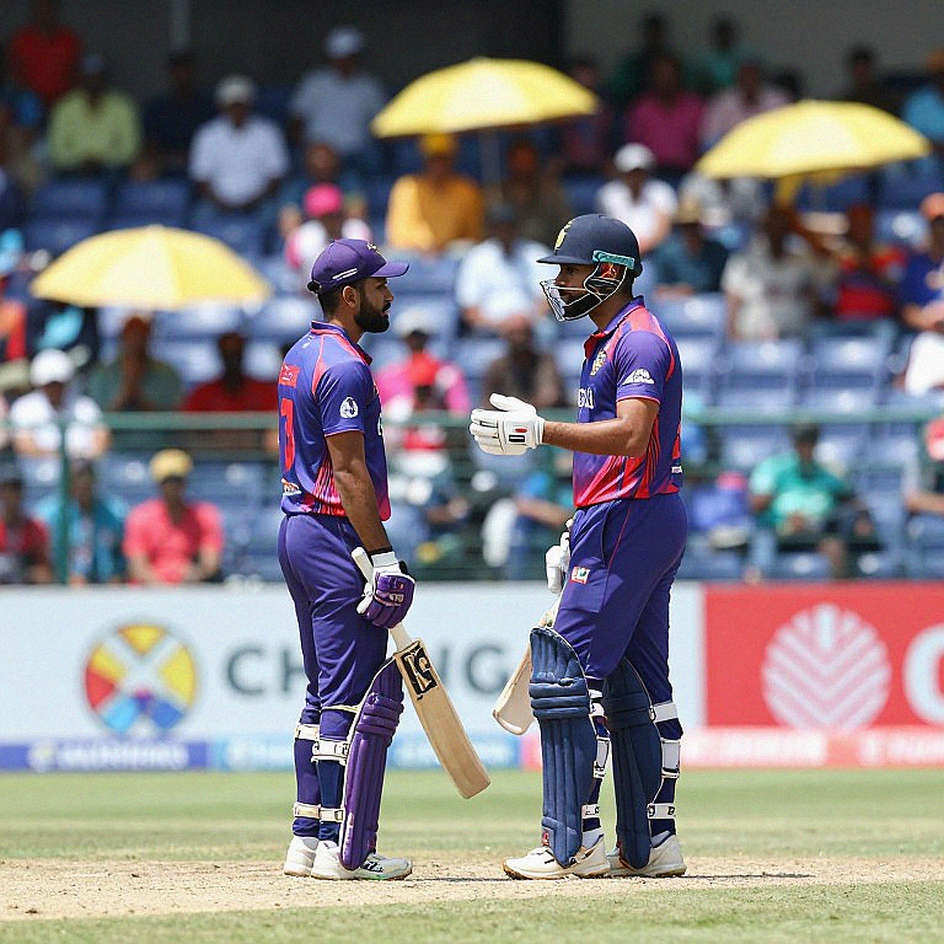
The MIG Cricket Club ground. An unremarkable afternoon of Mumbai club cricket. The scoreboard says the chase was 154, Suryakumar Yadav faced just 10 balls, made 17 runs at a strike rate of 170.0, with three boundaries. Then Karan Bhadra had him stumped. Innings over, cameo over.
That is all we have. What the match result was, we do not know. Who won the toss, we do not know. What the pitch was like, how humid the air was, whether dew fell — none of it is mentioned anywhere. In the journalism through which this reached us, every single fact carries, in effect, one word beside it: source — none.
The first discomfort lies here. Ten balls cannot judge a cricketer's form; that is a basic lesson. But the bigger question is elsewhere — why are we chasing ten balls, while a much larger story beside it slips past our eyes?
I keep returning to the rain, because it knew the score before we did.
Suryakumar Yadav's identity is now double-faced. On one side he is India's T20I captain — one of the most aggressive batting architects in white-ball cricket, whose job is to carry an innings from the middle overs to the death. On the other side, his first-class record is enviable: 5,758 runs in 86 matches at an average of 42.33, with 14 centuries and 30 fifties. That average, that century count — in India's domestic red-ball cricket, that is the numbers of the elite, where an average above 40 means high quality.
Yet in Test cricket his caps number one, his runs eight. This is the crack that keeps returning in the analysis, and it cannot be explained by a single number.
He had been out of competitive cricket since June. His last appearance for India was in the final of the T20 World Cup 2026. Then a break, a silence. That silence broke in a club and invitational T20 tournament like the MCA President's Cup, where MIG Cricket Club faced Muslim United Sports Club.
This tournament must be placed in its right spot. It is not an ICC event, not a bilateral series, not a major domestic tournament like the Syed Mushtaq Ali Trophy, and certainly not a franchise league. It is Mumbai Cricket Association club-level T20 — below even state-level domestic cricket. At this level, powerplay, middle overs, death overs — these phases mean very little. There is no capacity here to draw any prediction about international or even first-class performance.
Still, there is one fact that belongs at the centre of this whole discussion. Mumbai announced a 16-member squad under Siddhesh Lad for the opening round of the Ranji Trophy 2026-27. Suryakumar is not in it — yet he was available to play. "Omitted despite being available" — the real story hides inside this phrase, and it is the most overlooked part of this piece.
An empty stadium still breathes, and Coman.
In my twelve years of watching this game, one lesson has become clear: the scoreboard is sometimes the least informative document. It records runs, balls, the mode of dismissal. But it does not record who is playing and why, who is not playing and why. Here the scoreboard shows us 17 runs. But the story is being written where the scoreboard cannot reach — in the selectors' room, in the team's balance, in the ledger of workload management.
First, ten balls is no form verdict. Ten balls of one innings cannot tell a cricketer's condition. The benchmark for a T20 finisher is a strike rate in the 150 to 180 band. Suryakumar's 170.0 sits in that band, meaning the intent was there — three boundaries are its witness. But the sample is so small that no conclusion can be drawn from that intent. "The return did not go as planned" gives a 10-ball innings undue weight, and creates a wrong picture in the reader's mind.
Second, the stumping is a small but interesting signal. Stumping usually happens when a batter, beaten by a spinner's flight or turn, leaves the crease and the keeper breaks the stumps. This may hint at a weakness in the middle-overs spin matchup. But caution is needed here — one delivery in one match cannot justify that conclusion. It is a signal worth monitoring, not a verdict.
Third, and this is the real one: the Ranji omission is not a form verdict but a signal of format specialization. To leave out a player who is India's T20I captain, whose first-class average is above 42, who has 14 centuries, from domestic red-ball cricket — this is not mere rotation, it is a direction. A cricketer with 14 first-class centuries having one Test cap and eight runs — this very contradiction says the selectors have always seen him as a white-ball specialist, not as a red-ball failure. The distinction is subtle, but it changes everything.
Fourth, the age curve. If this 2026 timeline is accurate, he is now in his mid-thirties. The typical batting peak is between 27 and 33. Past this point, the question is no longer "returning to red-ball cricket" but "how to manage workload as a T20 specialist." This is no shame; it is the natural arithmetic of modern cricket management.
Read together, these four points show that the 10 balls in the MCA President's Cup are not an exam paper — they are a fitness session, an exercise in recovering rhythm. It may even be a publicly visible fitness checkpoint, if an international series awaits ahead. Sending a player down to domestic club cricket during a training phase — this is one real function of club cricket, which India's deep domestic infrastructure makes possible. A club circuit in every corner of the country means this: between international windows, a player can stay match-sharp.
— Root: The Empty Stadium and Coman
Now to the part where collective memory usually points its finger in the wrong place.
The first error is in the headline. "How did Suryakumar perform on his return?" — the question looks harmless, but its foundation is weak. With a 10-ball answer, the honest reply to "how did he perform" is one thing: nothing can be known yet. The template of the question is a search-friendly template, not an analytical one. The reader who came looking for a comeback story is shown a flash of ten balls and told this is everything.
The second error is in the absence. Those who were not in the game matter more here. Suryakumar's absence from the Ranji squad is the big event, yet it has been buried relative to the headline. When a 16-member squad is built without an available, first-class-proven batter, that is a clear message from the selectors — his place in the red-ball plan is shrinking, and the team is turning toward a young red-ball core. This is a quiet signal of generational change.
The third error is about sources. If every fact in this episode carries, in effect, "source: none," then we must admit — we are speaking with certainty on an uncertain foundation. The Ranji 2026-27, the T20 World Cup 2026 final — these timelines could not be independently verified. They need to be checked against ESPNcricinfo, Cricbuzz, or official ICC statistics. This is a weakness of journalism, and an honest analyst must admit it at the outset. No large decision can be built on an article whose every number is unverified.
The fourth, and most subtle error, is in perspective. We easily assume that format specialization means a kind of decline. The batter moves toward white-ball cricket not by his own wish but by an external calculation — this is not defeat, it is the labor management of modern cricket. Those who complain "Suryakumar never got his red ball back" miss a constructive truth: cricket has entered an era of single-format specialists, and the management of the Indian team is its clearest example.
No large commercial inference can be drawn here either. In this club tournament there is no information on broadcast rights, franchise valuation, auction, or salary. Inferring his auction position here would be idle talk, and such inference is the biggest trap in sports journalism. This tournament has one function — maintaining match fitness and rhythm.
The transfer window is a confessional where numbers hide the names.
So what do we look at, forward?
First, the next three to five innings. Only there is a real form verdict possible. What ten balls of one innings cannot do, five innings can shape into a pattern — then it can be said whether he is back in rhythm.
Second, the rounds after Mumbai's Ranji squad announcement. If the omission repeats, it must be taken as not temporary rotation but a permanent specialist label, which will narrow the future Test path further. If he returns, it is simply workload management.
Third, the modes of dismissal. Stumping, beaten by spin — if this recurs, there is work to do on the middle-overs spin matchup. So far it is inference, not proof.
Fourth, the upcoming international schedule. If he is named in a squad, this club outing was merely fitness preparation — nothing more. If he is not, the question grows more complicated.
And finally, a question to myself. The scoreboard told us 17 runs. But who will tell us whose the empty chair in a 16-member squad is, and why? The cricket we do not see is sometimes truer than the cricket we do.
I keep returning to that quiet ground. I do not know whether there was a crowd. I do not know the result. I do not know who won the toss. Yet, without a single mistake, one thing can be said — an empty stadium still breathes, and when Karan Bhadra's ball breaks the stumps, the arithmetic of ten balls and the story of fifteen minutes become one. We can argue that arithmetic until morning, but the truth is — the real story is still unwritten, and it is being written in Ranji's empty chair.
Related Players
Recommended
ILT20 Season 5 Opener: Desert Vipers vs MI Emirates — The Calendar Risk and Ownership Map Beneath the 'Blockbuster' Label2026-10-08
Testimony of an Empty Input: Why Cricket Analysis Demands a Verifiable Ledger2026-10-12
Blockchain and Cricket's Media Rights: Is the Token Light Rewriting the Economics of the Game?2026-10-09
Whom the Monsoon Chooses: How Bangladesh's Wet Season Builds Its Quicks — and Breaks Them2026-09-26
The NOC Is Not Paperwork, It Is a Veto: Pakistan Champions' Withdrawal and the Quiet Scoreline of Governance2026-10-07
Smart Contracts, Quiet Audits: Where Blockchain Actually Fits in Cricket's Transfer Market2026-09-27
The Last-Ball Frame: Sri Lanka's Nerve, Bangladesh's Lone Reliance, and an Unsourced Scorecard2026-10-06
Recommended
Mullanpur's Road, Gill's Test: The Scoreline That Doesn't Show India's Real Strength2026-10-04
The Empty Field and the Bought Ghost: Blockchain's Integrity Theatre in Cricket2026-10-06
The Zero Block: Why the 'Null Return' Is the Most Honest Answer in Cricket's Verification Ledger2026-10-12
Abhishek Sharma's 53 Runs — The Record That Has Not Entered the Ledger Yet2026-10-10
Bangladesh's Spin Dilemma Midway Through the Asia Cup: When the Mirpur Wicket Refused to Lie2026-09-30
Dew, Over-Rates and a Keeper's Silent Ledger: What Tempo Is Telling Us in Bengaluru's Domestic Season2026-10-03
Before the Door Closes: Shami, the Silence of Selection, and an Unnamed Voice2026-10-09
Not the Last Ball but the Middle Overs: Where Bangladesh's 'Almost' Is Actually Born2026-09-26
Recommended
Same Opponent, Two Notebooks: Bangladesh's Clock and Afghanistan's Rhythm in the Asia Cup2026-09-25
Empty Data Crisis in Blockchain Cricket Analysis Pipelines: Transparency Mandate and the Path to Future Correction2026-10-15
Cricket's New Ledger: Fan Tokens, NFTs and Asia's Franchise Economy2026-10-05
The Asia Cup’s Real Home Ground Is a Time Zone2026-09-27
Cricket Data Integrity and Blockchain: A New Over of Verifiability on Asia's Pitches2026-10-04
Zero Is Data: When the Cricket Analytics Pipeline Returns Empty2026-10-09
Attack or Defend? Shubman Gill's Confession and India's Road to 20272026-10-05
From the Empty Cell to the Truth: Cricket's Data Trust and the Limits of Blockchain2026-10-10